





Ben Baines
Network & Connectivity Alliance Lead
Ben Baines Linked In
Four weeks after a truly incredible Cisco Live EMEA, I’m reflecting on my top takeaways from an action-packed week at the RAI Convention Centre in Amsterdam.
Before diving in, I have to ask - can Cisco now be considered a security company? With the Splunk acquisition and Cisco’s Security business growing 108% in H1, it’s hard to argue otherwise. Security was Cisco’s fastest-growing architecture, now equating to over 20% of their entire product revenue - pretty impressive! And with the security innovations announced at Cisco Live, I expect these numbers will continue to accelerate.
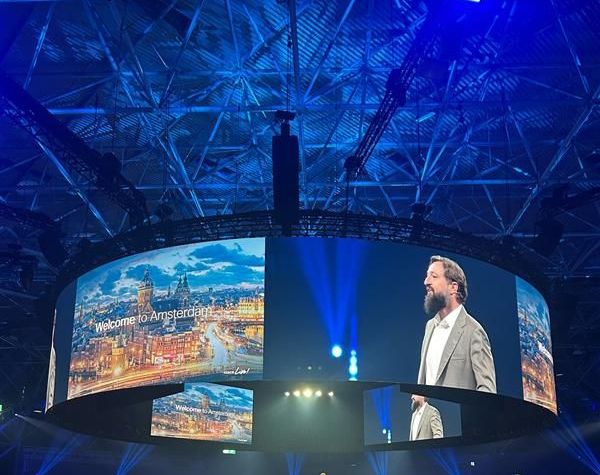
The opening keynote
On the main stage, an effervescent and hugely passionate Executive Vice President and Chief Product Officer, Jeetu Patel, set out his vision for Cisco and its product roadmap. It felt like a major gear shift for Cisco with a huge focus on research and development, and a desire to ensure they build great products that customers not only love, but would actively recommend to their peers. It was hard not to be won over by Jeetu’s enthusiasm of what’s to come.
Jeetu made it clear that quality is Cisco’s top priority. As he put it, “Cisco needs to be ten times better than our competition to allow our customers to be ten times better than their competition.” Cisco is backing this vision by investing 13% of its revenue into R&D.
There was a significant emphasis on security during the keynote, and it was clear that Jeetu’s focus remains in this area. The manner in which he weaved through the many updates was impressive, inviting his product team on stage for live demos, giving real validation to Cisco’s latest innovations.
The AI revolution continues
Cisco’s strategy is simple - unlock the power of AI, simplify and drive efficiency and strengthen digital resiliency.
Jeetu spoke of the ‘Deepseek effect’ – as the cost of entry to AI reduces, we can expect to see a surge in AI models, impacting both security and throughput of the network. He also spoke about the ‘Operator effect’ – a future where AI agents interact with each other autonomously, handling everyday tasks on behalf of users.
Cisco is positioning itself to support both the network and security demands of AI. It’s not just about low latency environments, but also enhancing skills, modernising infrastructure and ensuring AI safety and security.
Top five key announcements
1. Cisco Smart Switch
Cisco is launching its first pair of switches designed specifically for data centres, combining the super-fast performance of Cisco Silicon One® with the programmability of AMD DPUs. This combination lets the switch deliver better applications without slowing down the network, which is crucial for next-generation fabrics.
This allows one native security architecture that is built into your IT infrastructure – no need to add extra software or hardware to pass traffic and processes though as it’s all native on-device.
Cisco expect the N9324C-SE1U 24-port 100G option to be GA April 2025 and the N9348Y2C6D-SE1U 48-port 25G, 6-port 400G, 2-port 100G to be GA July 2025
2. AI Defence
AI Defence helps organisations protect both external AI applications and internally developed AI tools.
For external generative AI applications, it detects the usage of generative AI tools, allowing organisations to block unauthorised AI applications and monitor interactions to ensure the tool is being used responsibly.
For internal generative AI developments, it integrates into locally developed AI models via API, to validate them against threats and ensure security compliance (e.g. ISO42001). AI Defence can conduct vulnerability tests, allowing the user to configure policies to protect them, as well as introducing privacy and safety guardrails to protect the model from seeing sensitive information, or outputting dangerous or harmful content.
Linking AI Defence with Cisco Secure Access helps organisations detect and understand what SaaS driven AI tools are being used, such as HuggingFace. Now, native integration with the agents you already deploy as part of your secure connectivity suite can help control shadow-AI.
3. Universal Zero Trust Network Access (ZTNA)
Cisco has expanded ZTNA with hybrid private access to optimise the office experience without compromising data privacy.
Universal ZTNA features allow network administrators to use one platform to create and automatically apply a single policy for SSE and firewall at scale, which means that employees can automatically connect to their work applications regardless of location, instead of repeatedly reconnecting to the VPN.
4. XDR integration with Meraki
This will mean organisations can feed their Cisco XDR with telemetry directly from their Meraki MX appliance. As such, XDR incidents will populate their Meraki dashboard, giving administrators better visibility and faster threat response.
5. Expansion of Security Cloud Control
A centralised security policy and management platform for Cisco solutions - Security Cloud Control includes Secure Workload, Secure Access and AI Defence.
Cisco has shifted focus to prioritise integration over consolidation. Customers can now push policies out to third party security devices (Palo, Checkpoint, Fortinet) centrally, from the Security Cloud Control console.
Security Cloud Control allows you to manage all of your Policy Enforcement Points (PEPs) in one place - crucial for a true Zero-Trust model! You can even manage on-device policies like micro-segmentation agents from Illumio or Guardicore.
Cisco Live EMEA made it clear – Cisco is all-in on security and AI. With major investments in innovation and a clear roadmap, expect to see continued momentum in these areas.
Find out more about Softcat’s partnership with Cisco here.