





Gary Hawkins
Chief Technologist - Cloud and Datacentre
Gary Hawkins Linked In
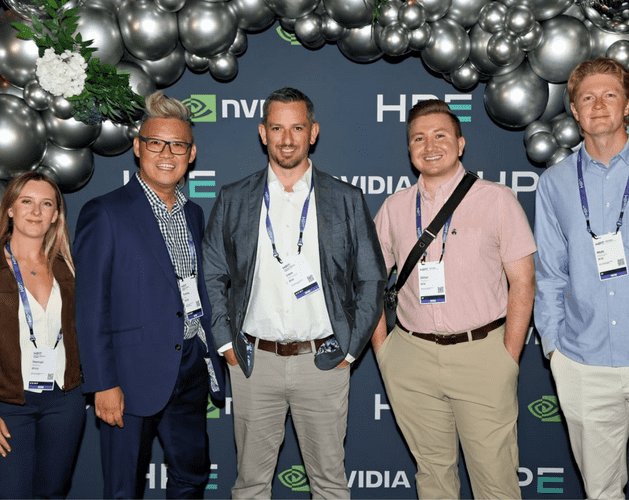
I've been going to HPE Discover for a few years now, but this one landed differently…
First up, HPE moved the celebration night to the Allegiant Stadium and featured a headline performance by Imagine Dragons. Now this is either a bold statement of intent or just proof that the Sphere (where the event was previously held) was booked up. Either way, the energy matched the event
Filling up our trophy cabinet
More to the point, we didn't just attend this year. Softcat won. Twice. Softcat was named HPE Global AI Partner of the Year 2026 and HPE UKIMEA Solution Provider Partner of the Year. We picked up both awards at the HPE Partner Growth Summit that runs alongside Discover.
Richard Wyn Griffith, our Chief Commercial Officer, summed it up well:
"In a time of significant change, the support HPE provides in helping customers identify the right technology platforms, from the datacentre to the edge, is more important than ever."
David Francis, our Alliances Director, pointed out that this recognition came at both a global and a local level, and is a reflection of more than two decades of building something that works for our customers, not just on a partner scorecard. Quietly proud doesn't quite cover it, but I'll leave it there.
There was lots to unpack across the week
The week itself was dense but pointed to one consistent argument: agentic AI succeeds or fails on the network first. Antonio Neri's, HPE’s President and CEO, keynote was titled "Architecting AI starts with your network", a deliberate signal that HPE isn't positioning the network as a supporting act any more. Rami Rahim, who leads HPE Networking post-Juniper acquisition, led a full general session on self-driving networks, moving from vision to production. Fidelma Russo, HPE's CTO and President of Hybrid Cloud, closed the picture out with the path to an agentic enterprise.
As not everyone could attend (although that would have been fun), here's what I took away from the event:
The network is the control plane, and HPE is making it self-driving and autonomous
A year on from closing the $14 billion Juniper acquisition, this was the event where HPE showed the work rather than the roadmap. The headline on the networking side: the self-driving network is no longer a concept.
In practical terms, HPE has delivered on the integration it promised when it bought Juniper. The HPE Networking CX switching portfolio, Aruba's wired access estate, is now supported in the HPE Mist platform (Juniper's AI-native operations layer). That means Aruba CX customers get AI-native visibility, zero-touch provisioning, service-level insights, and the Marvis AI assistant for troubleshooting, all from the same platform that's been running Juniper networks for years. Conversly, HPE Marvis’ self-healing capabilities are now available in Aruba Central, including autonomous wired port remediation. This sounds unglamorous until you've counted how many support tickets it would have generated the old way.
This "cross-pollination" strategy is the proof point the market has been waiting for. The two platforms are aligning on common hardware, shared agentic capabilities, and consistent AI-native operations. Neither network team needs to pick a winner; they're converging.
The AI data centre networking story is just as significant. HPE Juniper QFX Switches are now integrated into the HPE AI Data Center Solution, managed through the HPE Networking Data Center Director. The network bottleneck that slows GPUs down, forcing them to wait on data rather than process it, is now actively targeted by silicon and software built specifically for AI workloads.
HPE also launched a unified AI-native SASE platform, converging SD-WAN and Security Service Edge into a single management console. Zero-trust adoption at the network layer is something most organisations have been talking about for years. This makes it a lot less painful to actually get there. And there's a new Network Migration Program from HPE Financial Services — 0% software financing and a trade-in programme for existing kit — for anyone whose refresh has been sitting in a spreadsheet waiting for budget to appear.
As Rami Rahim put it: "The success of agentic AI in the enterprise depends on a modern networking foundation built for autonomous workflows."
Agentic AI in production: governed, not just announced
The AI factory story at Discover 2026 shifted from "here's what we're building" to "here's how you run it responsibly in production."
HPE Private Cloud AI, which was co-engineered with NVIDIA, gained a set of capabilities that address the actual problem organisations face when they start deploying AI agents at scale:
- Who approved this agent?
- What is it allowed to do, what is it costing?
- What happens when it does something wrong?
The answers, per HPE are:
- A centralised agent registry where you can register and govern agents built in any framework with zero code changes.
- The NVIDIA Agent Toolkit (including NVIDIA NemoClaw and OpenShell secure runtime) acting as an agent operating system for reasoning, monitoring behaviour, and enforcing policies.
- HPE Zerto being extended to identify rogue agent actions and rewind to a clean state.
That last one in particular — the ability to undo what an autonomous system has done — is the kind of capability that will determine whether IT leaders trust these systems with anything important. It's a sensible answer to a question a lot of people haven't thought to ask yet.
On the compute side…
HPE Private Cloud AI now scales to 256 GPUs for multi-node inferencing, with a unified model gateway for governed access to frontier models. The new HPE ProLiant Compute DL394 Gen12, built with the NVIDIA Vera CPU, is the compute foundation designed specifically for agentic workloads. This is set to land in 2027, so don't put it in the budget this quarter. The HPE Alletra Storage MP X10000 becomes the storage layer for Private Cloud AI, with native MCP support and real-time metadata enrichment, so agents can actually find and use the data they need.
NVIDIA’s Confidential Computing is now standard across the HPE AI Factory, protecting models and data during execution through cryptographic attestation. Jensen Huang put it simply: "Together with HPE, NVIDIA is building AI factories powered by NVIDIA Vera CPUs, accelerated infrastructure, and secure AI software to help enterprises transform data into intelligent action."
Sovereign AI Factory continues to cover government and defence use cases where data residency is non-negotiable. HPE AI Factory at Scale covers the neoclouds and service providers operating at a different order of magnitude. There's a tier for each type of organisation, which matters because the infrastructure requirements are genuinely different.
Virtualisation: HPE is now competing for the VMware conversation directly
This one barely needs a long preamble. Every customer conversation about infrastructure refreshes for the past 18 months has hit the same wall: what do we do about VMware licensing? HPE used Discover 2026 to stake out a clear position on this, rather than dancing around it.
HPE Morpheus Software (now at version 9), is positioned as an enterprise-grade, full-featured alternative to existing virtualisation platforms. It combines VM and container provisioning with integrated observability, AI-powered insights, and operations under a single per-socket subscription.
- Morpheus Central adds federated multi-site management.
- The Morpheus Orchestration Copilot handles natural-language provisioning.
Software-defined networking is now generally available within Morpheus, and HPE states it cuts provisioning time by up to 60% — these are vendor figures, so read them as directional rather than gospel, but the intent is clear. HPE Zerto's live workload migration from VMware to HPE virtual machines is part of the package too. Citrix is also in the picture, deepening its collaboration to deliver Desktop-as-a-Service on GreenLake for on-premises and sovereign environments.
From a partner perspective, HPE also introduced a 3x multiplier on software sales for Zerto, Morpheus, and OpsRamp. This helps us at Softcat, as we are having these conversations to move customers forward without the whole exercise becoming purely a hardware transaction.
GreenLake Intelligence: the operating model for the agentic enterprise
GreenLake has worn different hats over the years. At Discover 2026 its job is to be the unified operating model for everything: AI factories, hybrid infrastructure, virtualised workloads, and the agents that are starting to run across all of them.
GreenLake Intelligence is the agentic AI framework at the centre of it all — a centralised agent registry, intelligent planning and orchestration, and governance controls. The HPE OpsRamp Operations Copilot, available now, adds observability built specifically for AI agents and LLMs: monitoring utilisation, governing token-based consumption, and making the cost of running agents legible rather than a surprise.
From my perspective, GreenLake Intelligence is doing the right thing, building the governance layer before the agent sprawl gets out of hand. Most organisations I talk to are discovering that agentic AI creates a new class of operational complexity they didn't plan for. Knowing what agents exist, what they're permitted to do, what they're costing, and being able to reverse their mistakes — that's the operational scaffolding that makes the technology usable at scale, rather than impressive in a demo.
Bringing it all together
Strip away the casinos, bars and restaurants, Imagine Dragons and the keynotes inflection points, Discover 2026 was HPE executing on a clear thesis:
- Agentic AI succeeds on infrastructure, and HPE builds infrastructure.
- The network is the secure control plane.
- Private Cloud AI governs the agents.
- GreenLake Intelligence provides the operating model.
- Morpheus handles the virtualisation migration that half the market is overdue for.
- And finally, the Juniper acquisition has delivered a unified networking estate with genuine AI-native operations across the whole thing.
None of this is perfectly finished, as of yet. Some of the most interesting capabilities land later in the year or into 2027. But the direction is consistent, the execution is real, and the partner economics have improved meaningfully.
Being named HPE's Global AI Partner of the Year at Discover 2026 means Softcat customers get access to all of this through people who are close enough to HPE to understand what's ready now, what's worth waiting for, and what the right architecture looks like for your specific environment.
If any of what I've covered here is relevant to what you're planning — a network refresh, a VMware migration, an AI deployment, or just a clearer picture of your hybrid estate — speak to your Softcat Account Manager or one of our HPE specialists. We'd be glad to walk you through it!